
Medical projects

Clew

More Projects:

The Company &
the Product

CLEW Medical is an Israeli digital health company specializing in AI-based clinical prediction and patient monitoring, primarily for intensive care units.

Its platform combines real-time data from connected patient devices with clinical information from hospital systems, such as EHRs, and broader medical data related to the patient’s condition. The system uses AI to detect early signs of deterioration and predict when a patient may be at risk.

The technology has been used in clinical settings, including during the COVID-19 pandemic, and is designed to enable earlier intervention – up to several hours before deterioration becomes apparent through standard monitoring systems. This helps medical teams improve patient outcomes while managing hospital resources more effectively.

Project Goal

To define and design the full user experience for CLEW’s AI-powered clinical platforms, helping realize the vision of transforming ICU care from reactive treatment to proactive intervention.

The goal was not only to display alerts, but to position AI as a trusted clinical partner – one that helps ICU teams identify deterioration earlier, reduce alarm fatigue, and work more efficiently in one of the most intensive and high-stakes medical environments.

The challenges

Building trust in AI predictions

One of the biggest challenges in medical AI is trust: how do you get skeptical clinicians to rely on an AI system that predicts future patient deterioration?

The system provides predictions for the next few hours, helping medical teams intervene before traditional signs of deterioration appear on standard monitors. To make this usable in a high-stakes clinical environment, we had to address the “black box” problem and design trust into the experience from the ground up.

Fighting alarm fatigue

ICU environments are already saturated with alerts, many of which turn out to be false positives. This creates alarm fatigue and makes it harder for medical teams to distinguish between meaningful signals and background noise.

Our challenge was to design a system that would be perceived as the “signal,” not the “noise” – delivering alerts that are accurate, actionable, and valuable enough for clinicians to learn to trust and rely on.

Supporting multi-role clinical workflows

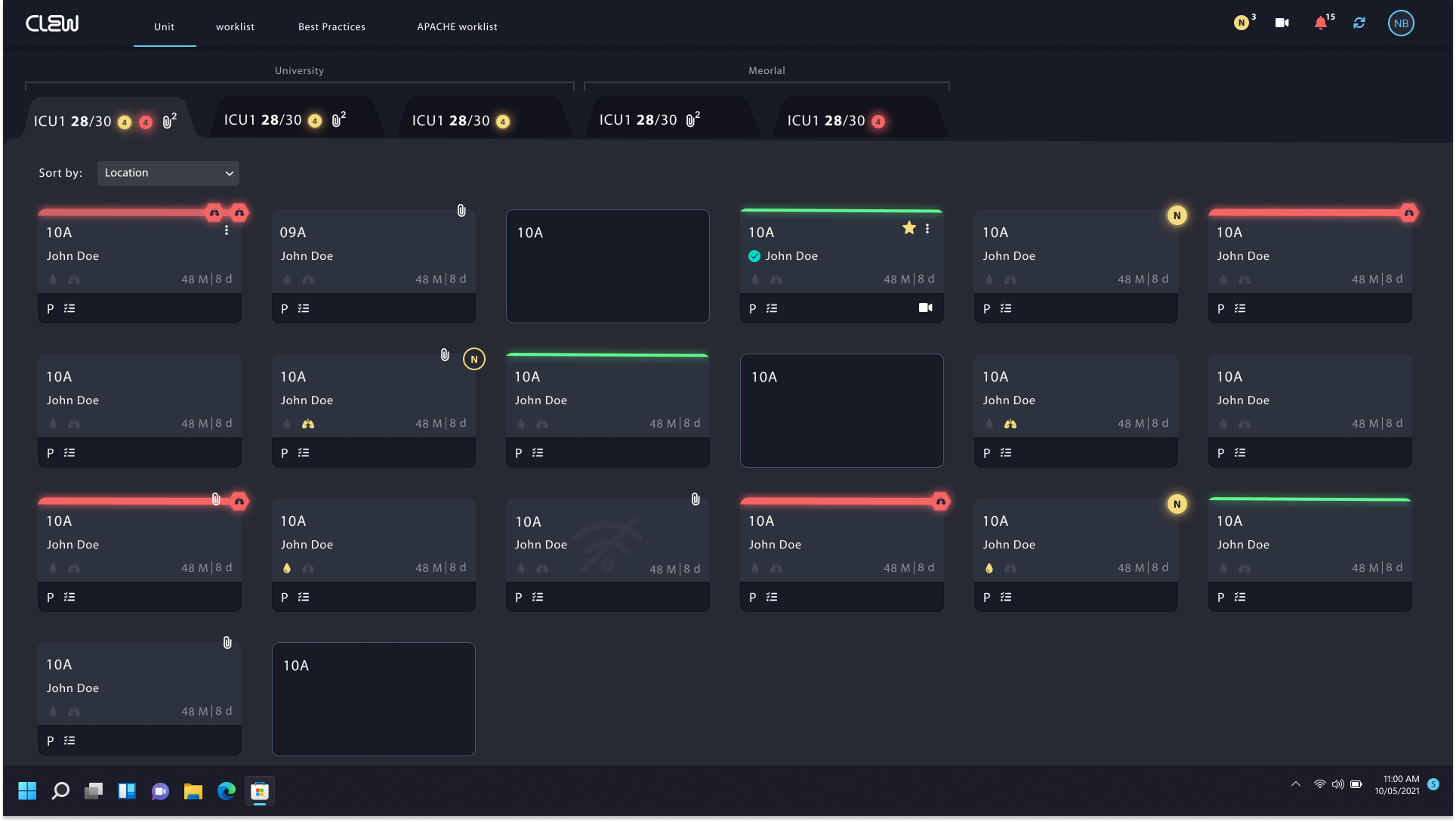
The system serves different types of clinical users, including bedside physicians, nurses, and tele-ICU teams managing multiple units remotely.

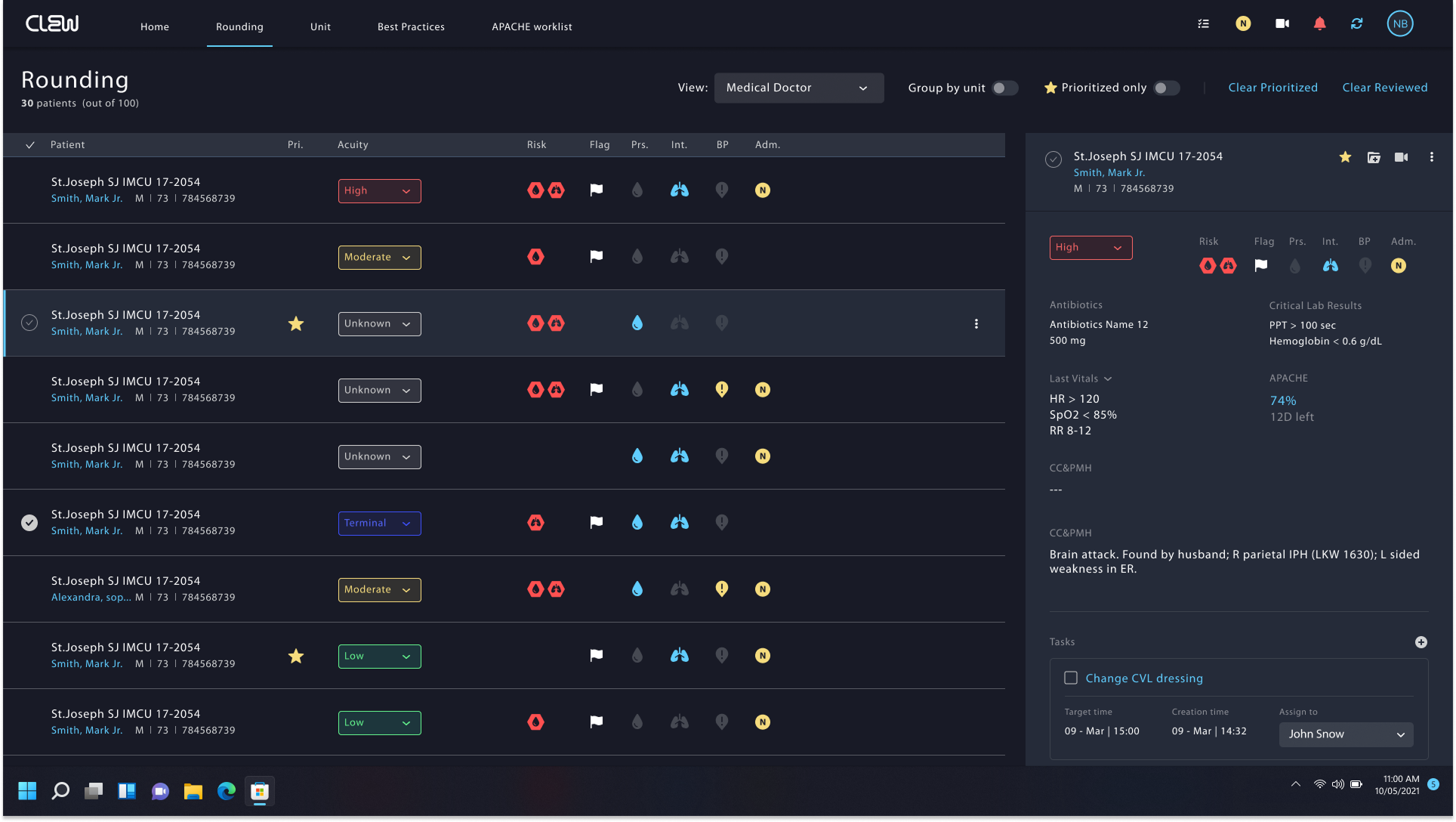
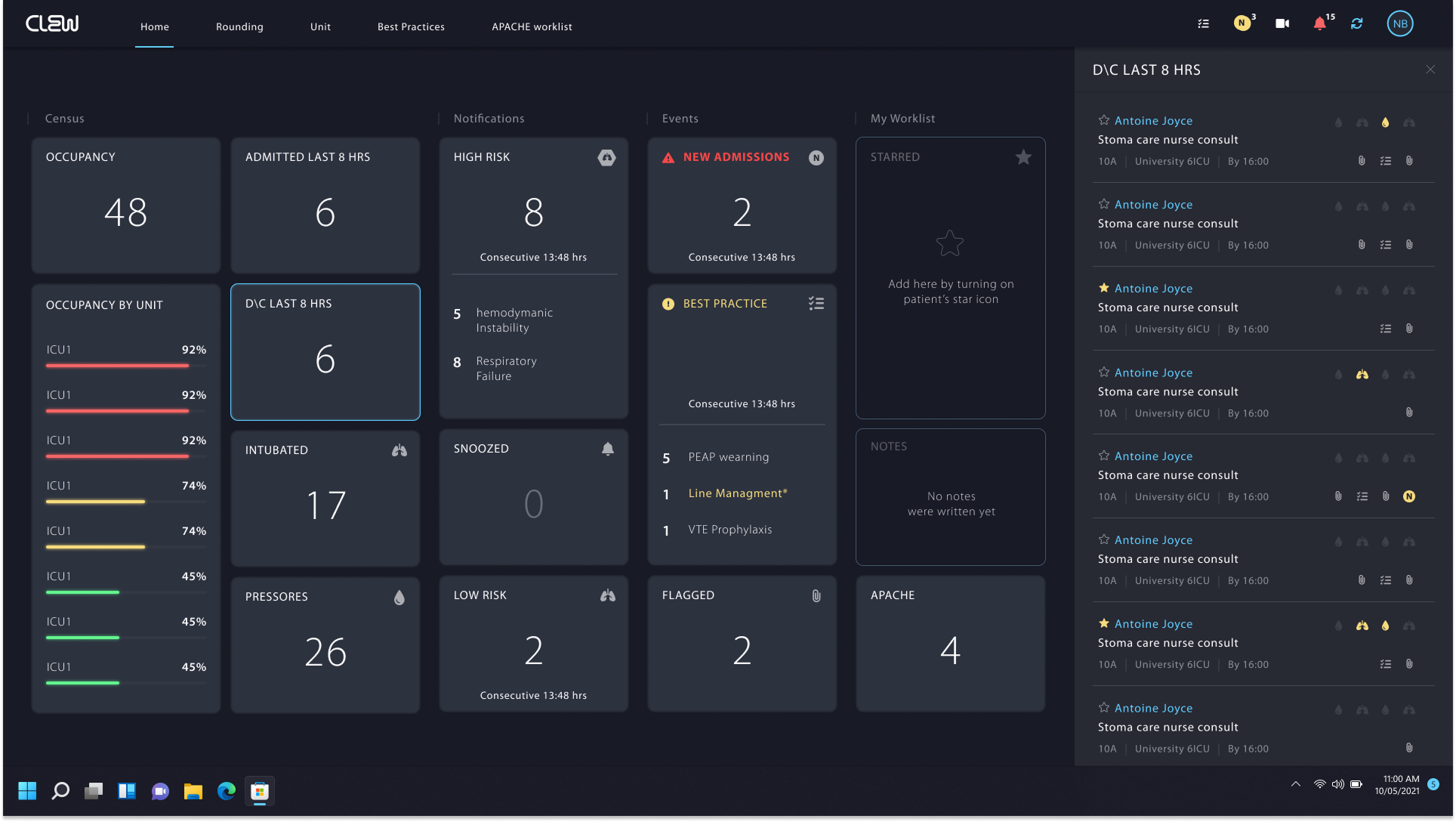
The challenge was to create a fast, efficient interface that supports both multi-patient monitoring and complete clinical workflows, such as virtual rounds and e-observation, while adapting to the different needs and responsibilities of each user group.

Executive Solution Summary

Executive Solution Summary

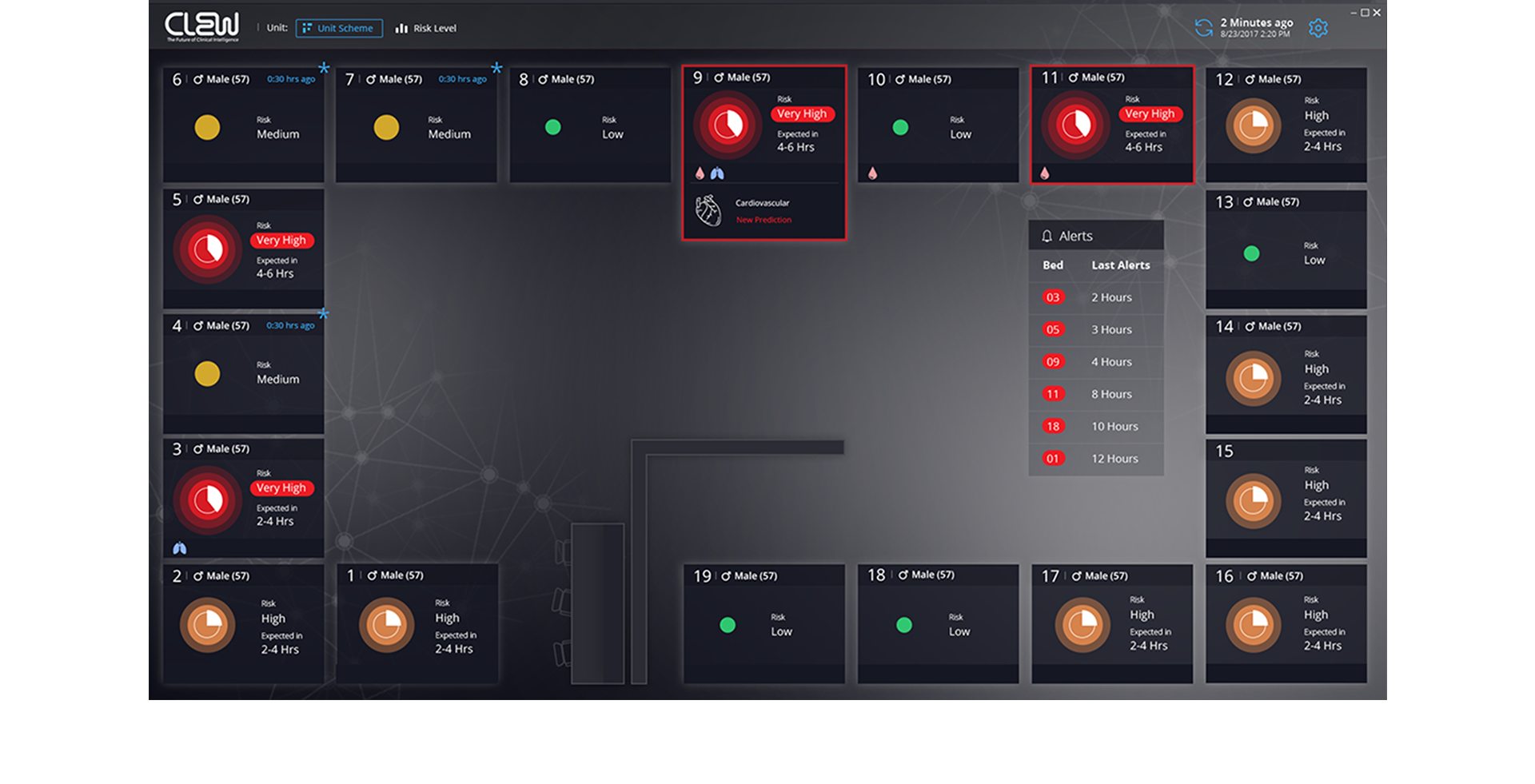
We designed a multi-patient dashboard that translates AI predictions and clinical risk into a visual experience that can be understood at a glance.

The dashboard includes a physical map of the ICU and patient cards that combine four critical pieces of information in one clear visual element: the clinical system related to the alert, the severity of the patient’s condition, the expected time range of deterioration, and the probability that deterioration will occur.

By using size, color, and graphic hierarchy, we created a fast and intuitive prioritization tool that helps clinical teams identify which patients require attention first and make smarter decisions under pressure.


Principles Behind the Solution

Group 1707478609
Group 1707478732 (1)
Group 1707478674 (1)

Explainable AI

We believed that trust in AI should not come from hiding complexity, but from making it understandable.

Instead of asking clinicians to simply “trust the system,” we designed for transparency. Every AI-driven recommendation needed to provide a clear explanation of the reasoning behind it, allowing users to access, with one click, a summary of the key findings and clinical signals behind each insight.

01
02

Clinical-First Design

To design effectively for clinicians, we immersed ourselves in the clinical workflow.

We interviewed doctors, observed ICU environments, and mapped real decision-making processes to understand how medical teams assess risk, prioritize patients, and act under pressure. The goal was to design a system that fits naturally into existing clinical workflows, rather than forcing teams to adopt new ones.

Glanceable Prioritization

In the ICU, not all patients require the same level of attention at the same moment.

Our approach was to use AI as a prioritization layer, helping clinical teams immediately understand where the highest risk is and which patients need attention first. In a high-pressure environment where there is little time to read or interpret complex data, we focused on a glanceable interface that communicates the full departmental picture quickly, clearly, and visually.

03

Our Solution

Fewer, smarter alerts - with clear explanations behind every prediction

Explainability as the Foundation for Trust

We understood that clinical trust was the key to the system’s success. For ICU teams to rely on AI-driven predictions, they needed to understand the reasoning behind each alert and recommendation — even if they ultimately chose not to follow it.

Instead of simply presenting a prediction, such as a high chance of deterioration, the interface allows clinicians to dive deeper with one click and see the Top Contributing Factors behind the alert.

The system shows not only the primary clinical system expected to deteriorate, but also related systems that may be involved. It also enables users to review how the key contributing parameters developed over time, in one coherent display designed to support clinical decision-making.

By exposing the analytical reasoning behind the prediction, the system helps build the confidence required for preventive intervention – while keeping the final clinical decision in the hands of the doctor.

Prioritized and Focused Notifications

We designed the alert strategy to reduce noise and fight alarm fatigue.

Instead of flooding ICU teams with too many low-confidence alerts, we raised the threshold for notification. The system surfaces only alerts that the AI identifies as highly likely and clinically meaningful.

This approach was based on a simple principle: trust increases when the number of alerts is lower, but their quality is higher. By focusing on fewer, more accurate alerts, the system helps teams pay attention to what matters, prioritize patients more effectively, and respond before deterioration becomes visible through standard monitoring.